
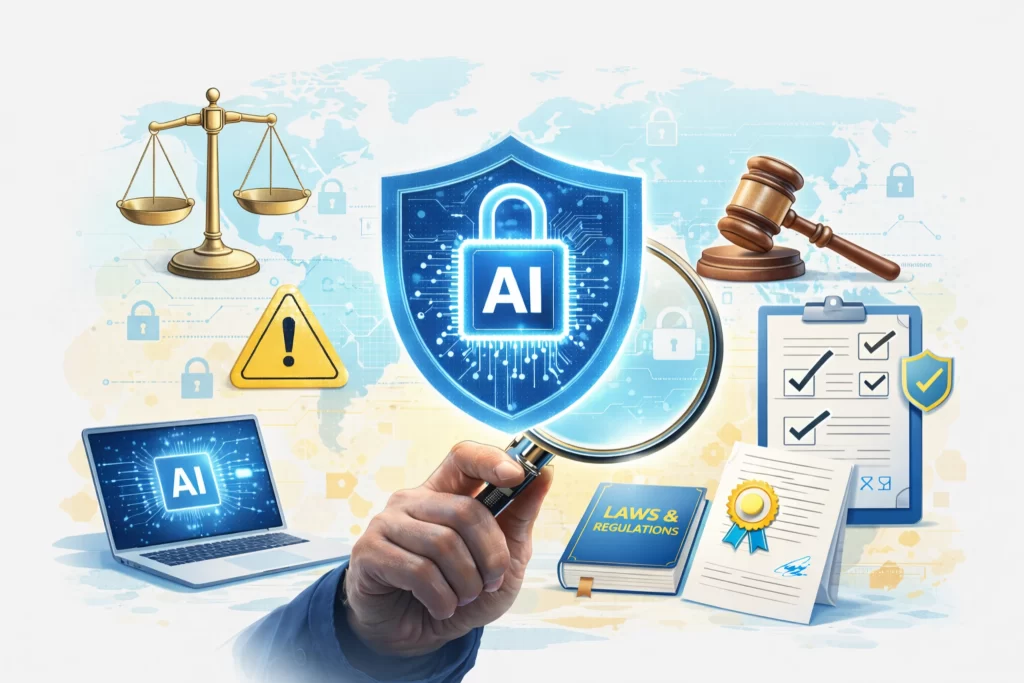
For many beginners, this is the quiet question sitting in the background:
“Am I allowed to use AI… and could it get me in trouble?”
The short answer is: yes, AI is generally safe and legal to use — when used responsibly.
The longer answer is what this page is for.
The Simple Truth About AI and Safety
AI tools are not inherently dangerous.
They don’t:
- Act on their own
- Access your private life
- Make decisions without input
AI responds only to what you choose to give it.
Most safety concerns come from how AI is used, not from the technology itself.
If you’re brand new, start with the basics in What is AI? A simple explanation for beginners
Is Using AI Legal?
In most countries, using AI tools is legal.
You are allowed to:
- Use AI to write drafts
- Use AI to brainstorm ideas
- Use AI to summarize information
- Use AI to assist with creative work
What matters is how the output is used, especially in public or commercial settings.
AI itself is a tool — like spellcheck, calculators, or photo editing software.
Where Legal Problems Can Actually Happen
Problems don’t come from using AI.
They come from misuse.
Common risky behaviors include:
- Claiming AI-generated work is fully human-created when rules forbid it
- Using AI to copy protected content directly
- Sharing private or confidential information with AI tools
- Using AI to deceive, scam, or impersonate others
If something would be illegal or unethical without AI, it’s still illegal with AI.
To avoid beginner pitfalls, review Common AI mistakes to avoid
Is AI Content Copyrighted?
This is one of the most confusing areas for beginners.
In simple terms:
- You generally own the content you generate with AI tools
- But AI-generated content may not always qualify for full copyright protection
- Laws vary by country and are still evolving
The safest approach:
- Use AI to assist, not fully replace, human input
- Edit, customize, and improve AI-generated content
- Avoid copying large chunks of recognizable material
Structure and human oversight matter more than automation.
Learn how structure helps in How AI tools work together
Is AI Safe for Personal Use?
Yes — with basic common sense.
Best practices:
- Don’t share sensitive personal data
- Don’t upload private documents unnecessarily
- Assume anything you enter could be stored or reviewed
- Use reputable, well-known tools
AI tools are generally safer than people think, but they’re not private diaries.
To understand which tools are best for beginners, see Popular AI tools explained.
Is AI Safe for Work or Business?
In most cases, yes — but with boundaries.
Many companies already use AI for:
- Drafting content
- Research
- Internal documentation
- Customer support
However, some workplaces:
- Require disclosure when AI is used
- Restrict what data can be shared
- Have specific AI usage policies
If AI is used at work, follow the same rules you would for any software tool.
The Biggest Ethical Line Beginners Should Not Cross
The clearest rule:
Don’t use AI to mislead people.
Avoid using AI to:
- Fake expertise
- Impersonate real individuals
- Generate false reviews or testimonials
- Create deceptive content
AI should assist, not manipulate.
This is where human judgment always matters.
Why Systems Matter More Than Rules
Most safety and legal issues disappear when AI is used inside clear systems.
Systems:
- Define what AI does
- Limit where it’s used
- Keep humans in control
That’s why experienced users rely on workflows instead of one-off AI usage.
To see how this works, read AI workflows explained
What Comes Next
Once you understand what’s safe and allowed, the next step is using AI confidently, not cautiously.
That’s where structured setups help.
Continue with Beginner AI tool stacks
Or learn repeatable systems in AI workflows explained
Is AI Safe and Legal? Frequently Asked Questions
Yes. It is legal to use AI tools in most countries. Legal issues generally only arise if the tools are used for fraud, copyright infringement, or deceptive practices.
Yes, you can publish AI-generated content. However, for the best results and to meet the terms of most platforms, you should review, edit, and add human oversight to the output.
Ownership depends on local laws, but generally, you own the output. However, content created entirely by AI without human modification may not be eligible for full copyright protection.
No, it is not safe to share sensitive personal information with AI. Most AI models store data to improve their systems, so you should treat AI prompts like public forums and avoid sharing passwords, financial data, or private documents.
Only if it violates company policies or involves sharing restricted data. Always follow workplace guidelines.
Whether AI is “cheating” depends on the context. In professional settings, it’s a productivity tool; in academic settings, it depends on specific institutional policies and disclosure rules.
No, AI laws are currently evolving and are not yet settled globally. While some regions like the EU have established frameworks (like the AI Act), most countries are still determining how to handle copyright, liability, and data privacy
Use AI as an assistant, review outputs carefully, and stay involved in every step.
AI isn’t dangerous.
Using it carelessly is.
AI Safety 101: Key Legal Terms
| Term | Lab Concept |
|---|---|
| Public Domain | Creative work that is not protected by copyright. Some AI laws suggest that unedited AI content belongs in the public domain, meaning anyone can use it. |
| ToS | The “Rules of the Road” for an AI tool. In the Lab, we check the ToS to see if a tool allows its output to be used for making money. |
| Data Scraping | How AI companies collect information from the internet to train their models. This is currently the center of many AI legal debates. |
| PII | Short for Personally Identifiable Information (like your SSN or home address). Rule #1: Never put PII into a public AI tool. |
| Intellectual Property | Legally protected “creations of the mind.” We use AI to support our IP, but we add Human Oversight to ensure it stays protected. |
| Disclosure | Being honest about using AI. Many platforms require you to “disclose” (label) content if it was made with AI tools. |
| Opt-Out | A setting in many AI tools that stops the company from using your chats to train their future models. Great for business privacy. |
| Liability | Legal responsibility. If an AI gives bad advice and you publish it, you are usually the one held responsible, not the AI company. |
 Alex Carter