

Introduction to Chat GPT
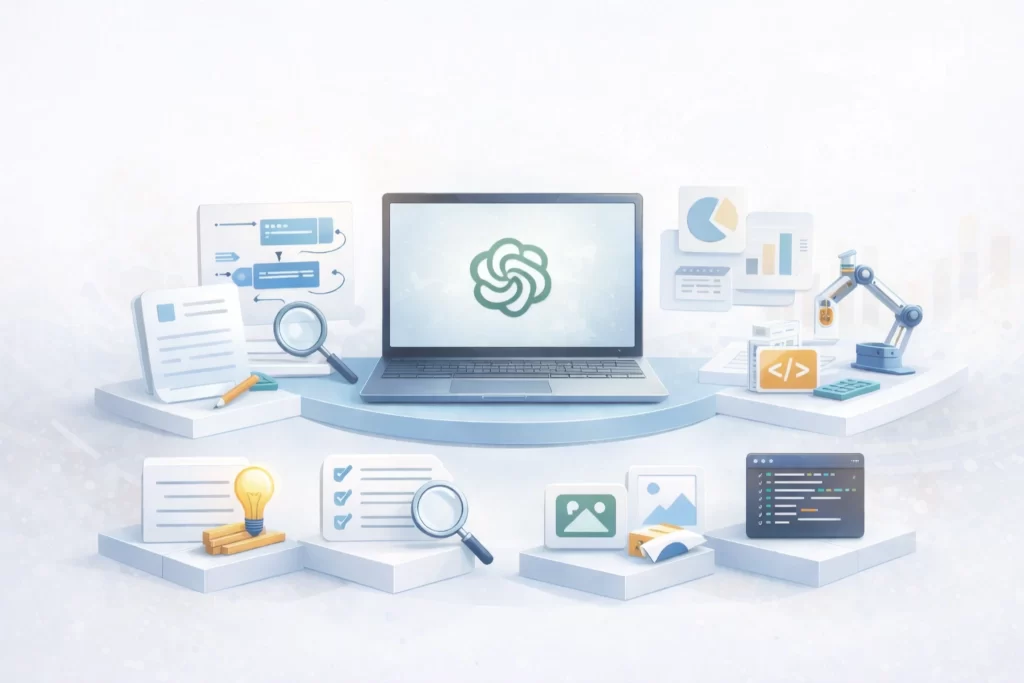
ChatGPT is a general-purpose AI tool that can write, edit, summarize, brainstorm, code, analyze data, and even generate images.
For side hustlers, it’s more than a writing assistant. It’s a flexible production tool. You can use it to draft blog posts, create YouTube scripts, build outlines, write product descriptions, generate social captions, debug code, plan workflows, and design simple graphics.
Instead of jumping between multiple apps, many creators use ChatGPT as a central workspace for thinking, creating, and refining ideas.
This guide explains how ChatGPT is used in real side hustles, where it works best, and how it compares to other AI tools in practical workflows.
How To Get ChatGPT
What ChatGPT Actually Does
ChatGPT is a general-purpose AI tool used to:
- Generate written content
- Outline and structure ideas
- Summarize research
- Rewrite and improve drafts
- Brainstorm headlines and angles
- Write and debug code
- Generate simple images
- Analyze data
- Plan workflows
Instead of staring at a blank page, users start with direction — then refine.
That reduction in friction is what makes ChatGPT powerful for side hustlers.
How People Actually Use ChatGPT to Build Online Income
ChatGPT itself doesn’t pay you.
The income comes from what it helps you produce.
ChatGPT enables people to create:
- Blog articles
- YouTube scripts
- Email newsletters
- Digital products
- Freelance writing services
- Client research briefs
- Website copy
- Automated content systems
The faster you think → the faster you create.
The faster you create → the faster you publish.
The faster you publish → the more opportunities you build.
Why ChatGPT Works So Well for Side Hustles
Most beginners don’t fail because their ideas are bad.
They fail because:
- They overthink
- They stall
- They can’t organize their ideas
- They move too slowly
ChatGPT removes that bottleneck.
1️⃣ It Eliminates the Blank Page
You can generate a structured draft in minutes instead of hours.
2️⃣ It Speeds Up Iteration
Instead of rewriting manually, you can say:
- Make this clearer
- Shorten this
- Add examples
- Improve flow
And refine quickly.
3️⃣ It Supports Repeatable Systems
You can build workflows like:
Topic → Outline → Draft → Edit → Publish → Repurpose
Once structured, the process becomes predictable.
Predictability is what allows income systems to scale.
How ChatGPT Fits Inside a Real AI Workflow
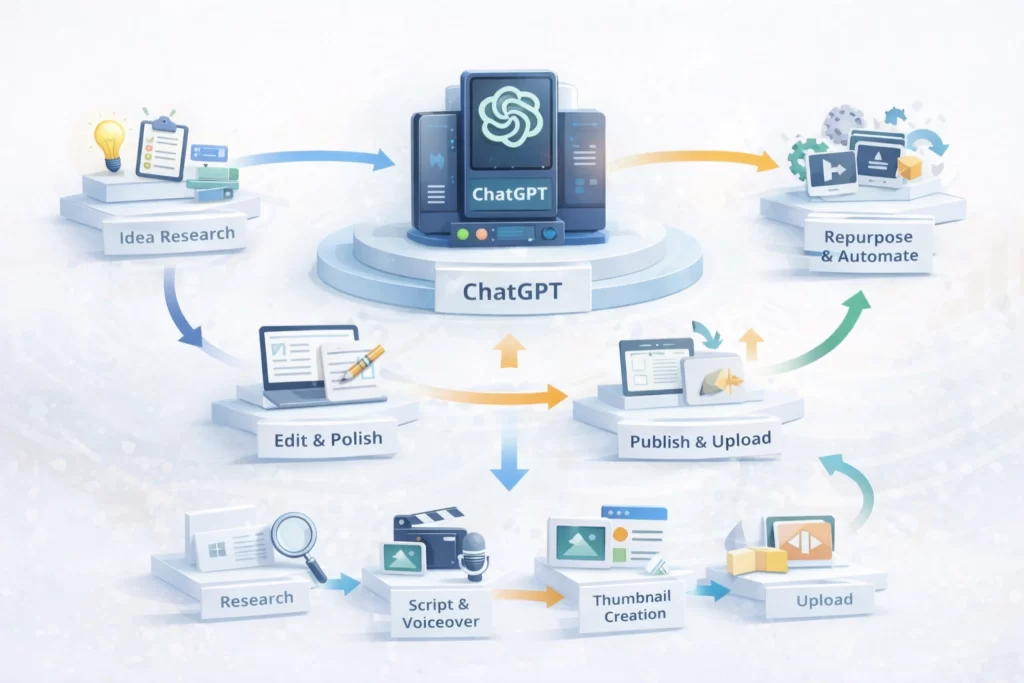
This is where most people miss the big picture.
ChatGPT is rarely the entire system.
It’s the thinking engine inside the system.
A typical SideHustleLab-style workflow might look like:
Idea → ChatGPT Draft → Edit & Polish → Publish → Repurpose → Repeat
Or:
Research → Script → Voiceover → Thumbnail → Upload
ChatGPT handles the heavy thinking.
Other tools handle formatting, visuals, and automation.
Used alone, it’s helpful.
Used inside a structured workflow, it becomes leverage.
Lab Note: Prompt Clarity Beats Prompt Length
Quick Tip: Most beginners think longer prompts equal better results. With ChatGPT, clarity beats complexity every time.
Be specific about the outcome, format, and tone you want. Short, structured instructions often outperform long rambling ones.
In the Lab, we treat ChatGPT as a thinking engine, not a magic button. Clear inputs produce powerful outputs.
Essential ChatGPT Terminology
| Term | What It Means |
|---|---|
| Prompt | The instruction or question you type into ChatGPT to generate a response. |
| Model | The AI engine powering ChatGPT. Different models may vary in speed, reasoning ability, or features. |
| GPTs | Custom-built versions of ChatGPT designed for specific tasks. They can include special instructions, uploaded files, tools, or workflows to focus on one purpose (like writing, research, or automation). |
| System Instruction | Background guidance that shapes how ChatGPT responds, such as tone, role, or formatting rules. |
| Context Window | The amount of conversation ChatGPT can remember at once while generating responses. |
| Regenerate | A feature that allows you to request a new version of the previous response. |
| API | A developer interface that allows apps and websites to connect to ChatGPT programmatically. |
Frequently Asked Questions About ChatGPT for Side Hustles
Most creators use ChatGPT to generate blog posts, YouTube scripts, email sequences, product descriptions, and research summaries. When combined with publishing systems outlined in our AI Workflows guide, it becomes part of a repeatable content engine designed for traffic growth and monetization.
Yes. ChatGPT is especially useful for outlining, structuring, and drafting SEO-friendly blog content. It works best when paired with human editing and strategic keyword research. Many publishers use it inside systems to increase content velocity without sacrificing clarity.
Absolutely. ChatGPT removes technical barriers by simplifying writing, research, and brainstorming. For beginners, it serves as a structured thinking assistant. We recommend starting with a simple workflow from our Beginner AI Stack to avoid overwhelm and build confidence quickly.
No. It can assist with drafting and ideation, but strategy, editing, and voice still matter. Many freelancers use ChatGPT to speed up research and first drafts while maintaining human oversight. In structured systems like those explained in our AI Tools Lab, it functions as a productivity amplifier — not a replacement.
ChatGPT is strong for structured output, idea expansion, and workflow integration. Other tools may specialize in editing or niche writing formats. For most side hustlers focused on scaling content production, ChatGPT works best as the central “thinking engine” inside a broader AI tool stack.
ChatGPT is best used for planning, outlining, drafting, and systemizing content creation. If your goal is consistent publishing, traffic growth, and long-term monetization, it serves as a foundational tool inside repeatable AI-powered workflows.
 Alex Carter