
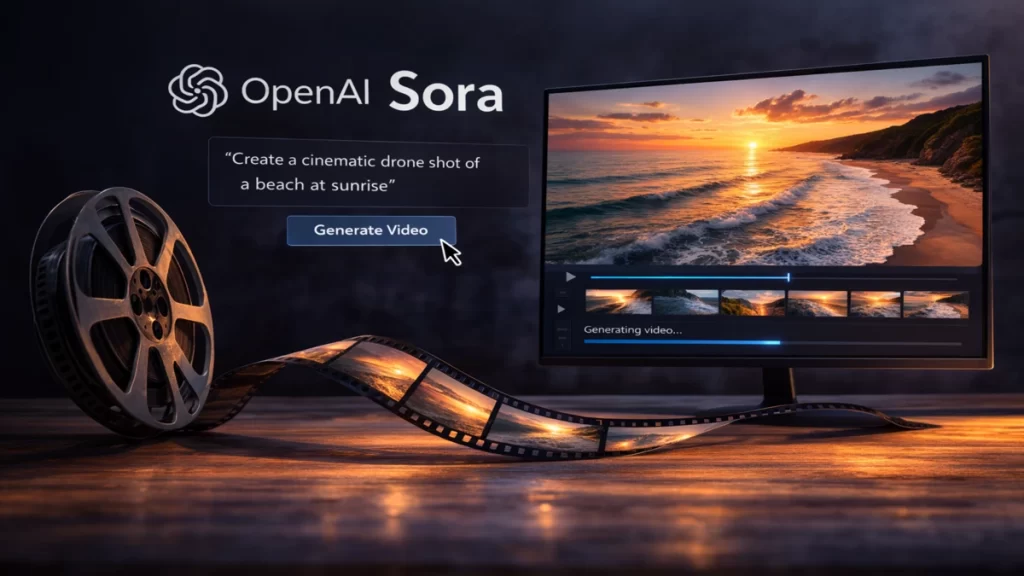

Introduction to OpenAI Sora
OpenAI Sora is an AI video generation tool that creates short videos from text prompts.
Instead of writing content or generating images, Sora focuses on turning descriptions into realistic motion scenes. You describe what you want to see, and it produces video clips based on that idea.
For side hustlers, Sora has potential in areas like short-form content, concept visuals, social media clips, and creative storytelling. It reduces the need for filming equipment or complex editing software when simple visual scenes are needed.
This guide explains how OpenAI Sora fits into content workflows, where it shows the most promise, and how it compares to other AI-powered video tools.
How To Get OpenAI Sora
What OpenAI Sora Actually Does
Sora is an AI video generation model that:
- Creates video clips from text prompts
- Generates realistic motion scenes
- Simulates environments and camera movement
- Produces short visual sequences
- Helps prototype video ideas quickly
Instead of filming or editing traditional footage, users describe the scene they want and generate video content directly.
That shift from recording to prompting is what makes Sora different.
How People Actually Use OpenAI Sora to Support Online Income

Sora doesn’t pay you directly.
The income comes from the video content you create and where you publish it.
Sora helps people produce:
- Short-form social videos
- Concept clips for marketing
- Visual storytelling scenes
- Background footage
- Promotional video snippets
- Creative content for faceless channels
The stronger your visuals → the more attention you capture.
Attention is what drives growth across video platforms.
Why Sora Works for Side Hustles
Many creators struggle with video production because:
- Filming takes time
- Equipment can be expensive
- Editing software has a learning curve
- Certain scenes are difficult to capture
Sora reduces those barriers.
1️⃣ It Eliminates the Need for Filming
You can create scenes without cameras or lighting setups.
2️⃣ It Speeds Up Concept Testing
Instead of fully producing a video, you can generate visual concepts quickly.
3️⃣ It Expands Creative Possibilities
You can create scenes that would be difficult, expensive, or impossible to film traditionally.
How Sora Fits Inside a Real AI Workflow
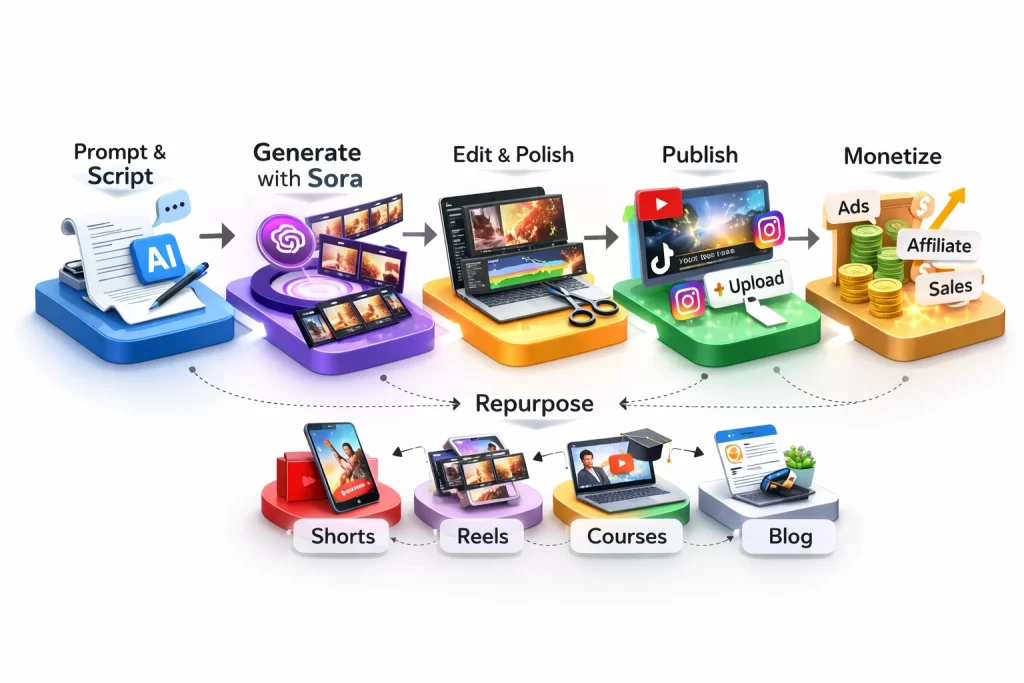
Sora usually handles the visual scene generation layer.
A common workflow might look like:
Script → Scene Prompts → Generate Clips → Edit → Publish → Repurpose
Or:
Idea → Visual Prototype → Final Video Production → Distribution
Sora handles motion visuals.
Other tools handle scripting, editing, voiceover, and publishing.
Used occasionally, it enhances creativity.
Used strategically, it can support scalable video-based content systems.
Lab Note: Think in Scenes, Not Sentences
Quick Tip: Sora performs best when you describe motion, camera angles, lighting, and environment — not just the subject.
Instead of writing “a dog running,” try “a golden retriever sprinting through a foggy field at sunrise, cinematic tracking shot, soft depth of field.”
In the Lab, we treat Sora as a scene simulation engine. Direct it like a filmmaker, not a typist.
Essential OpenAI Sora Terminology
| Term | What It Means |
|---|---|
| Text-to-Video | The process of generating video scenes directly from written prompts. |
| Prompt | The written description that defines the scene, motion, lighting, and style of the video. |
| Scene Consistency | The AI’s ability to maintain realistic objects, characters, and motion across frames. |
| Frame Rate | The number of frames generated per second, affecting video smoothness. |
| Cinematic Rendering | High-detail visual output designed to simulate real-world camera motion and lighting. |
| Clip Duration | The length of video that can be generated from a single prompt. |
| API Access | Programmatic access allowing developers to generate video inside apps or workflows. |
Frequently Asked Questions About OpenAI Sora for Side Hustles
OpenAI Sora is a text-to-video AI model that generates short video clips from written prompts. It is designed to simulate motion, scenes, and visual storytelling using natural language instructions. For creators building scalable content systems, Sora represents a shift toward AI-assisted video production.
Access to OpenAI Sora may be limited depending on rollout phases and platform updates. Availability can change over time, so creators should check official OpenAI updates for the latest access information.
In most cases, yes. Sora generates video sequences, but editing software is typically needed for branding, pacing, captions, and final formatting. When organized inside structured publishing systems like those described in AI Stack for Creators, AI video generation becomes one component of a broader workflow.
Sora focuses on generating realistic motion and scene continuity from text prompts. Other AI video tools may emphasize avatars, short-form automation, or editing enhancements. The best choice depends on your content goals and monetization model.
You can explore broader tool breakdowns and system positioning inside Tool Stacks.
OpenAI Sora works best for producing scalable visual content that supports YouTube monetization, affiliate marketing videos, and digital education products. When integrated into structured learning frameworks such as Learn AI, it becomes part of a repeatable production system rather than a standalone experiment.
 Alex Carter