
Which Video AI Tool Is Best?
Video AI tools are moving fast — but not all of them are built for the same purpose.
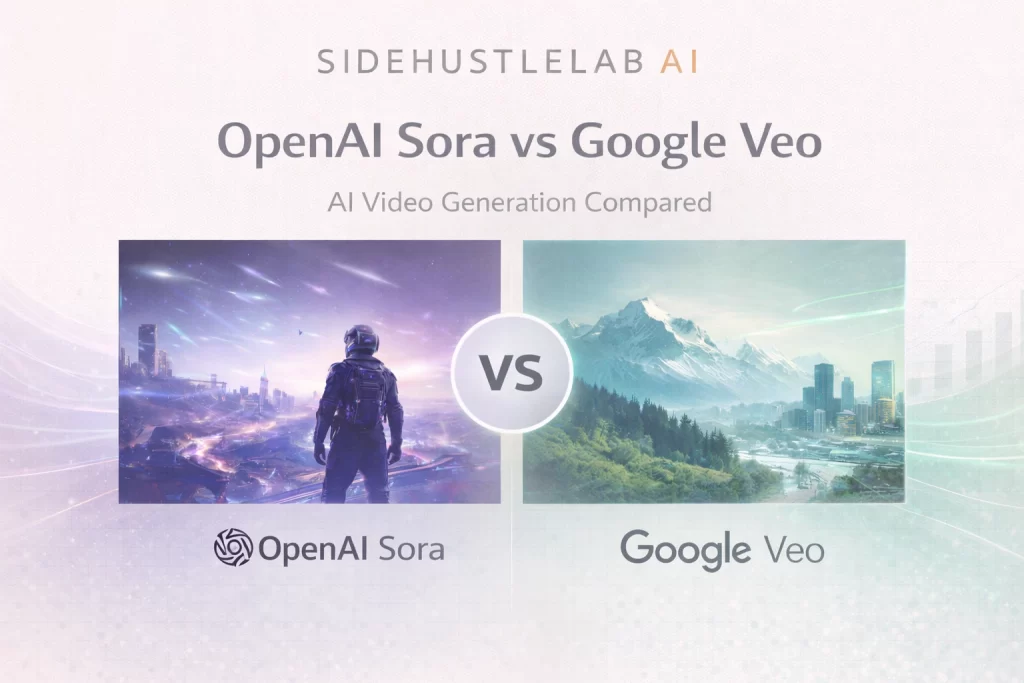
OpenAI Sora and Google Veo both generate video from text, yet they approach the problem from very different directions. One emphasizes storytelling and scene flow, while the other focuses on visual realism and cinematic quality.
This guide breaks down how Sora and Veo compare, what each tool does best, and how to decide which one makes sense for you.
No hype. Just clear differences.
Quick Overview
- OpenAI Sora → Text-to-video storytelling and scene generation
- Google Veo → Realistic, cinematic video generation
Both are part of the Video AI category, but they’re optimized for different creative goals.
Side-by-Side Comparison
OpenAI Sora vs Google Veo


OpenAI Sora: Storytelling & Scene Flow
OpenAI Sora is designed to turn written scenes into moving video. It’s often discussed for its ability to create clips that feel like moments from a story rather than isolated visuals.
Best used for:
- Visualizing scripts or written scenes
- Storyboarding ideas
- Exploring narrative concepts
- Experimenting with motion and pacing
If your goal is “show me this moment as a scene,” Sora is usually the better fit.
Google Veo: Realism & Cinematic Visuals
Google Veo focuses on how real a scene looks, emphasizing lighting, motion, and cinematic quality.
Best used for:
- Visualizing realistic environments
- Exploring camera movement
- Testing cinematic ideas
- Creating film-style concept clips
If your goal is “show me what this could look like on screen,” Veo is often the stronger option.
Which One Should You Choose?
A simple way to decide:
- Choose OpenAI Sora if you care more about storytelling, scenes, and narrative flow
- Choose Google Veo if you care more about realism, detail, and cinematic visuals
Many people don’t choose just one — they explore both depending on the idea.
Using Sora and Veo Together 🧪
In SideHustleLab.ai, these tools aren’t rivals — they’re different lenses.
A common approach:
- Use Sora to visualize a story or moment
- Use Veo to explore how that scene might look realistically
This keeps creativity flexible while grounding ideas visually.
To see how tools connect:
Learn How to Get Better Results from Video AI
Both Sora and Veo depend heavily on clear scene descriptions.
To improve results:
These skills apply across writing, image, and video AI.
There’s no “better” video AI tool — only a better fit for your goal.
Sora shines when ideas are narrative-driven.
Veo shines when visuals need to feel real.
Understanding the difference helps you choose intentionally instead of guessing.
OpenAI Sora vs. Google Veo: Frequently Asked Questions
OpenAI Sora focuses on storytelling and scene generation, while Google Veo emphasizes realistic, cinematic video output.
OpenAI Sora is generally better for visualizing stories and narrative scenes.
Google Veo is designed to produce more realistic, film-like visuals.
Access to both tools is limited and may change as the technology evolves.
Yes. Many users explore ideas in Sora and then visualize realism with Veo.
Both tools are generally safe to explore when used responsibly and according to platform guidelines.
 Alex Carter